Dispatches from Infocomm 2025
Providing an opportunity to deep dive into all things audiovisual, our team attended Infocomm 2025 and came away with a clear view of where the industry is heading and how the incremental product improvements on show could unlock new possibilities in digital displays, speakers, and amplifiers for our customers
This June, the world’s leading audiovisual experts descended on Orlando, Florida for this year’s Infocomm: the largest professional audiovisual trade show in North America. Attracting global manufacturers, integrators, dealers, and end users, the event showcases the latest technology, products, and services to emerge in the fields of audio, display, video, digital signage, and more. Over 800 companies exhibited, 250 speakers shared their insights, and 30,000 people were in attendance, including the Mood Media team.
With some of our team members regular Infocomm attendees and others visiting for the first time, they were universally impressed with the scale of the event and the range of exhibitors on offer. The team also expressed value in the opportunity to have in-person interactions with their industry peers (a rare occurrence now that home working has become more prevalent and workforces are spread across the country).
As
Drake Maxwell, our Director of Enterprise Business Development, put it: “This was my first time attending Infocomm and I was blown away by its size - it was one of the biggest events I’ve ever seen and a fantastic learning experience.”
After a packed three days in Florida, here’s what impressed our team the most at Infocomm 2025, the developments that led to the most heated debates, and the new technology that could transform the way brands work with audiovisual systems in the future:
Concealed Amplification
For those interested in the audio half of audiovisual technology, the team agreed that the technology on show favoured interesting improvements on existing products rather than revolutionary new launches - with one notable exception.
“It’s fair to say that the audio specialists at Infocomm this year were mostly presenting ideas that improve - and expand - their existing product range,” agreed
Ross Brown, Systems Design Architect.
That exception? A zero Ohm device that claims to be able to connect an infinite number of 8 Ohm speakers without experiencing any degradation of volume or frequency bandwidth.
“It’s the new product that I’m probably most keen to test,” explained
Randy Meadows, Systems Design Architect. “If it can deliver on its promises, it could be extremely useful for retailers who need to retrofit audio into their stores.”
Amplification Alternatives
Alternatives to traditional 70V or 8 Ohm sound systems were presented by several brands, a trend that was noted by our VP of Systems Sales, Greg Gershon, and one that is likely to continue to evolve in the coming years.
In the world of amplification, Powersoft amplifiers attracted the attention of
Mike Dirks, Senior Technical Project Engineer.
“I was impressed by how Powersoft was able to integrate their amplifiers into various audio products, and that includes Dante amplifiers,” Mike clarified. “There are a whole host of benefits to being able to run PoE to such a small amplifier; it’s convenient and ideal when working with modular displays. The amplifiers also sounded great despite being demonstrated in a busy show space.”
Concealed Speakers
Elsewhere, exhibitors were showcasing new ways to conceal speakers, which could unlock new possibilities for physical retailers, especially those experimenting with experiential or creating a distinctive aesthetic.
“Sonance demonstrated several different ways that their speakers can be concealed or blended into different architectural elements within stores,” shared
Brian Kelly, our Senior Director of Systems Sales. “Examples on offer ranged from hidden ceiling speakers to models that could be installed on steps so that customers can walk over them.”
Increased Clarity
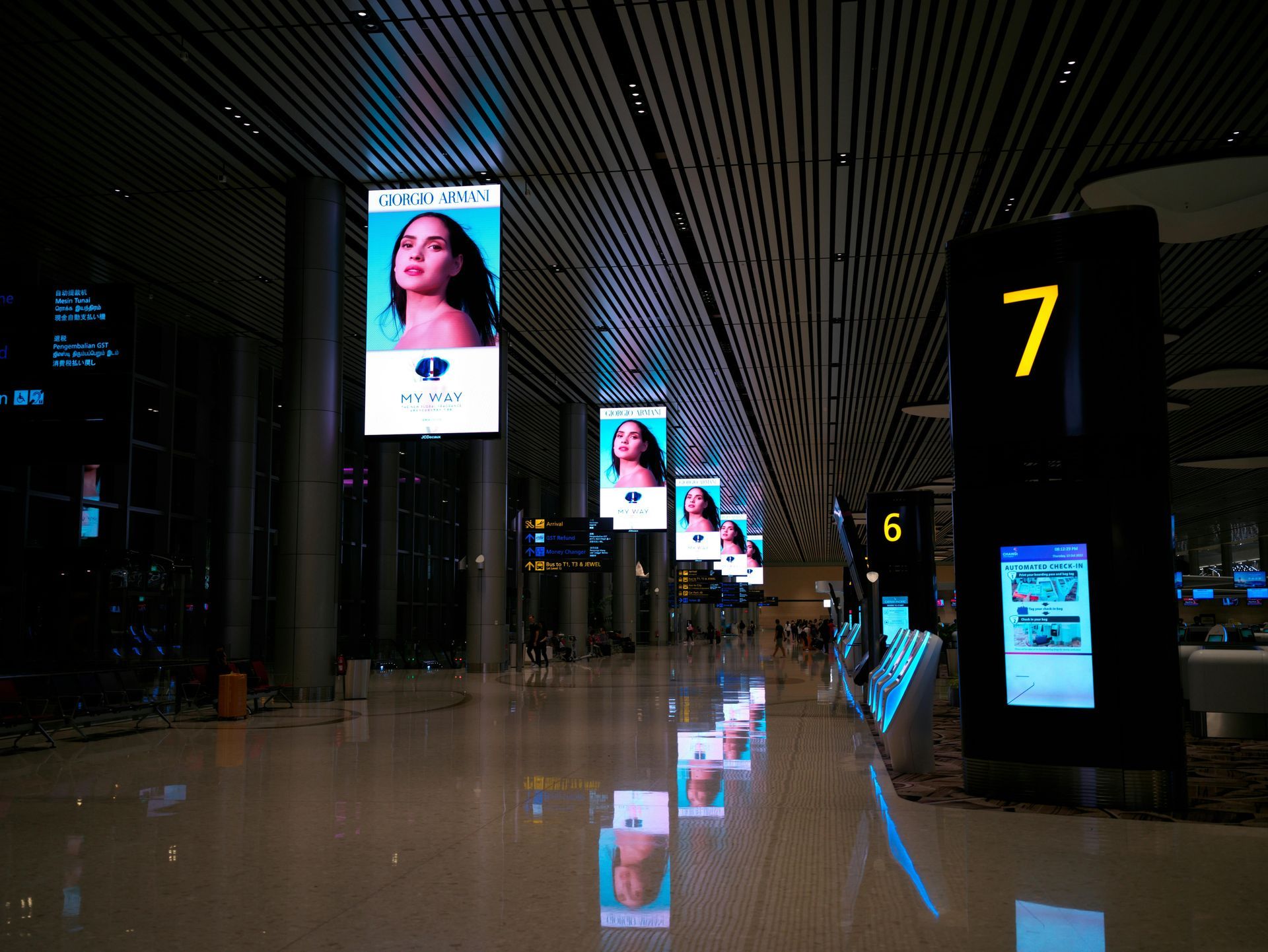
One of the more surprising aspects of this year’s Infocomm for both new and returning attendees was the increased focus on LED displays and their related technology.
“I did have the opportunity to go to InfoComm Las Vegas in 2024, but there were a lot more LEDs than I was expecting here,” commented
Tanesha Akers, Design Manager.
“I’d estimate at least 30-40% of the show space was dedicated to LED displays, it was by far the most dominant category,” agreed John Belt, Technical Project Engineer.
Ultra-black Displays
In such a crowded field, only the most exceptional new products stood out.
“I have to call out Sony’s ultra-black display technology, I’d consider it a gamechanger,” praised Systems Design Architect,
Jay McCutcheon. “The lack of reflection it had compared to other displays was really something.”
“The depth of black it is able to reach is great for both accessibility and readability,” Randy added. “The on-screen definition and enhanced text clarity were both seriously impressive.”
“It’s one of the products I saw that could instantly benefit our customers,” agreed Ross. “When presented on Sony’s ultra-black displays, content would be visible from wider angles, which would be ideal for customers looking at a restaurant board from the side or trying to watch a screen while queuing around a carousel.”
Direct View LED
While Sony was leading the way when it comes to ultra-black displays, one trending product popped up at almost every manufacturer's stall: direct view LED.
“Nearly every display manufacturer has a large all-in-one direct view LED product, so much so that the market is almost flooded,” Ross continued. “The benefit of these displays is that they can stretch beyond the traditional size limits of LCDs. An LCD display will usually be capped at around 100 inches, but these direct view LEDs can span hundreds of inches.”
Clear LED
Clear LED could also offer opportunities for our customers to use display screens more creatively without obstructing the rest of the store.
“I spent some time at the Clear LED booth, which highlighted the benefits and possibilities of this technology very effectively,” explained
Craig Breigle, Senior Director of Systems Sales. “They can be deployed as hanging banners, in window displays, and more.”
Dynamic Displays
While not yet tried-and-tested, innovations within LED that caught our team’s attention also included new ultra-thin dual-sided displays and those designed to make content appear as though it’s reaching out of the screen.
“I think there was more movement in the display world than in audio this year,” Ross noted. “One product that caught my eye was Liantronics’ new thin back-to-back display.”
Dual-Sided LEDs
This extremely slim, dual-sided LED display - and others like it - also impressed Michael Roper, Technical Designer. “The displays I saw were less than 2 inches wide but could offer two back-to-back displays with different resolutions to suit outdoor and indoor viewing.”
“It’s an innovation that closely mirrors what we’ve seen in LCD window display technology, but with a much thinner profile,” added Greg.
3D LEDs
Michael was also intrigued by 3D LEDs with undulating imagery. “These displays were interesting visually, but I’m not sure how well they’ll fare in the real world. I’m a little concerned about the potential risk of breakage.”
The energy consumption of LEDs compared with similar technologies was also a topic of discussion at Infocomm, with several stands, including Ledman, breaking down exactly how different technologies consume different quantities of power, supported by real-time readings.
Eyes on E-Paper
Reflecting trends we saw at ISE 2025, e-Paper and e-Ink made an impression on our team. Dinocan’s wireless e-Paper was especially noteworthy as it presented an opportunity for drive-thru menus or similar window signage that might not have easy access to a mains power source.
“They work by using an IR emitter to transmit voltage to the back of each display,” explained Jay. “The technology should be able to power a 13-inch e-Paper screen from a distance of up to 5 meters.”
However, it’s important to note that while e-Paper is evolving and becoming much sharper, it might not be a cost-saving solution for retailers looking to replace their LCD displays.
“More and more people are releasing e-Ink products, but they’re not necessarily any less expensive than LCD technology,” Greg cautions. “A 43-inch e-Ink display isn’t likely to be any cheaper to buy upfront than an LCD display, and the lifetime costs can also be higher.”
Emerging Themes
While the technology on display at Infocomm 2025 may not have caused our team to rethink everything they know about audiovisual, it still gave them plenty to consider. Themes that we saw emerge at ISE, such as the expansion of e-Paper and LED sustainability, were continued at Infocomm, while developments to improve display clarity and conceal speakers could have an immediate impact on our customers’ audiovisual setup.
Innovations like devices that can connect infinite 8 Ohm speakers and LED displays with 3D images emerging from the screen may spark conversation, but most manufacturers are focused on incremental improvements that can be deployed into the market at speed. The overall trend in audiovisual is clear: improve sound quality and display clarity while keeping the technology that lies behind these enhancements as small and discreet as possible.
About the authors:
- Greg Gershon - VP Advanced Solutions Group
Greg joined Mood Media in 1993 and has served as global lead of systems sales, design and solution architecture since 2019. During his 30-year career with Mood, he has served in a variety of capacities that include direct sales and account management, local sales management, regional sales management, and general management. Greg’s extensive experience makes him a subject matter expert. His responsibilities have increased from a North American focus to a global one over the past five years.
Engage with
Greg.
- Ross Brown - Advanced Systems Design Architect
Ross has been part of the AV industry since 2001 and has served a variety of roles. With a strong engineering foundation in the live performance space and theater productions, his focus with ASG is in hospitality and resort spaces, as well as speciality retail and restaurant verticals. Ross carries a vast array of certifications that include CTS, Netgear AV/IP and Switch Networking Certification, QSYS Level 2, Symetrix Composer, AV/IP Solutions, Bose ESP and Audio Product Certification, and Dante Level 2, among many others.
Engage with Ross.
- Michael Roper - Director of LED Sales Engineering
Michael has been a vital component of our Sales Engineering team for over 16 years. With extensive experience in using every type of LED technology imaginable, he has become an LED expert for key projects. His deep relationships with overseas manufacturers ensure that the products chosen meet our standards while keeping the overall costs within budget. His attention to detail and practical, hands-on experience in LED systems and innovative technology design enable him to play a key role in many projects.
Engage with Michael.
Linked Articles:
- ISE 2025: https://us.moodmedia.com/blog/industry-lens/ise-2025-retail-tech-trends-insights/
- NRF 2025: https://us.moodmedia.com/blog/successful-innovation-requires-mastering-the-fundamentals-first-nrf-2025s-surprising-insights/
- National Restaurant Association Show 2025: https://us.moodmedia.com/blog/restaurant-digital-signage-takes-center-stage-key-takeaways-from-the-2025-national-restaurant-association-show/