
The role of technology in experiential retail
With the rise of eCommerce, technology has already transformed shopping habits. It’s impact on physical retail has been just as profound.
Many retail institutions have been forced to enter administration and images of abandoned storefronts paint a bleak picture. In recent years, many have advocated for brands to focus on their online presence and move away from physical locations altogether.
In contrast to this pessimistic outlook, physical retail has undergone a resurgence. Customers aware of the limitations of online have started to seek real-life experiences and connections instead. And it’s a trend that looks set to continue; in fact, 81% of Gen Z prefer to shop in-store.[1]
What constitutes the in-store experience has also evolved. When virtually every item imaginable is available at the click of a button, regardless of personal preference, brands need to offer something special to entice customers away from their screens and onto the shop floor.
Experiential retail provides that reason to visit – and technology makes it all possible.
Brands can now curate multisensory spaces that prioritise providing a memorable experience, one that is immersive and interactive, and makes the financial transaction feel secondary.
Technology in action
Retail technology is most effective when it’s used intentionally.
The possibilities are virtually unlimited, but just because the tools are available doesn’t mean that every brand should strive to implement cutting-edge tech into their stores for the sake of it.
And when every pixel on a digital display consumes energy and contributes to the store’s carbon footprint, the impact of each tech solution deployed needs to be carefully considered and implemented with purpose.
That said, technology can play several roles in experiential retail spaces including:
- Interactive and visual displays
Serving a dual purpose, interactive displays can inspire and inform customers while also enabling them to complete tasks more easily. Whether it’s a touchscreen directing customers to in-depth content related to the latest collection or a customisation tool to allow personalisation, these displays complement visual installations, which serve to create a distinct store atmosphere or tell the brand’s story.
- Bespoke fragrance
Scent is one of the most effective ways to evoke a memory or create a recognisable atmosphere. Stores can use one single scent throughout the store to create a signature brand fragrance or curate in-store zones, using different scents to elicit desired responses.
- Sonic landscaping
Creating a sonic landscape in-store is more complex than simply building playlists of licensed music, although any track played should reflect your brand identity and be geographically relevant. A truly immersive sonic experience incorporates evocative audio that adds interest: think the rush of a waterfall or calming birdsong in spa waiting areas or hotel lobbies.
- Augmented and virtual reality
Augmented reality or AR has entered the experiential retail space, for the most part, by offering virtual try on. This technology has been embraced by beauty and apparel brands who know their customers are motivated by a try before you buy experience. There’s no need for a beauty emporium to worry about wasted product or health and safety concerns when customers can simply try on each shade of lipstick or eyeshadow virtually and still buy with confidence.
- App integration
With 60% of customers[2] who make a purchase through a mobile app likely to make at least one more purchase, brands have a good reason to incentivise downloads. By pairing the app with the in-store experience, they can capitalise on digital insights by offering targeted promotions, loyalty programs, and more.
Efficiency vs. Enjoyment
In the competitive luxury market, brands must balance investment in experiential retail with discreet technological advances that streamline operations, improve customer service, and increase margins.
Headsets can be used to deliver on-demand product knowledge to associates, machine learning can predict footfall and stock requirements, and app integration can provide customers with a personalised experience that inspires loyalty.
Maximising the moment
Technology is most impactful when it is used to create a memorable moment.
“When it comes to technology in the luxury space, less really is more,” explains Jonathan Wharrad, VP Global Retail Brand Experience at Mood Media. “Hyper-specific and personalised experiences bring more value than simply investing in tech for tech’s sake.
“If a brand wants to incorporate digital displays, for example, it’s important to remember that the content is equally as important as the number of pixels on offer. It’s not just wallpaper, every display should serve a purpose.”
Personalisation takes this to the next level, on both an individual and group scale. Driven by social messaging, insights gathered from analysing buying habits, or events such as changes in the weather or daypart, personalisation instantly elevates the luxury in-store experience. Displays can dynamically change, the store’s sonic identity can subtly shift, and different items highlighted to reflect the customer’s buying preferences as if by magic.
Spotlight on: Future Stores
One way that brands can take experiential retail for a test-run with minimal risk is to try a pop-up store. If you want to create a memorable moment, a store that’s open for a limited time is ideally suited to that mission.
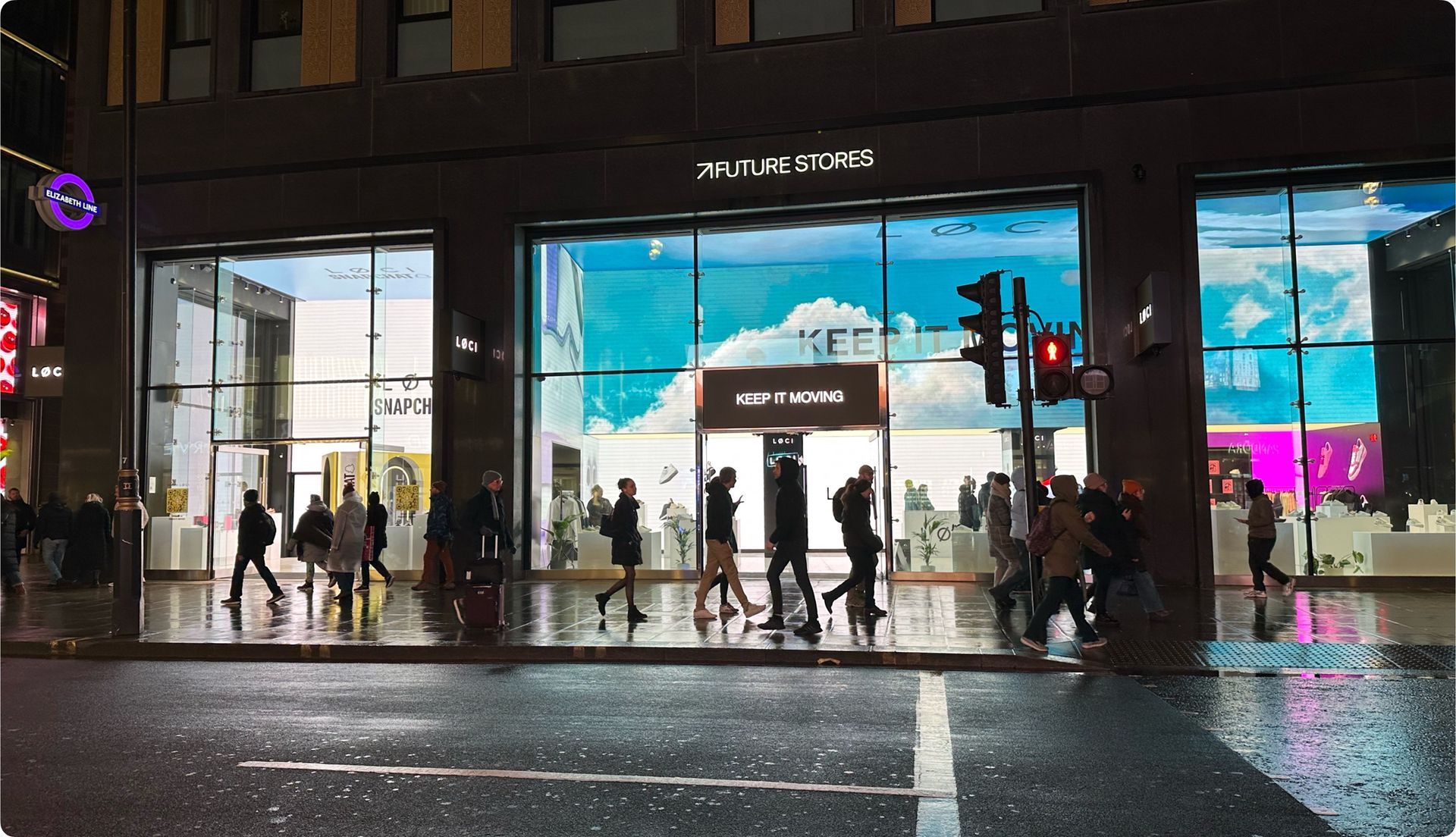
Future Stores on London’s Oxford Street is more than just a pop-up; it’s a manifestation of the future of retail, underpinned by cutting-edge technology. Inspired by the dynamic nature of a social media feed, Future Stores is a transformative space that brands can take over to showcase their story.
When it comes to technology, it’s a visual playground. A high-definition LED display of over 435 square metres with nearly 170 million pixels and 6700 LED tiles on a single canvas utilises NovaStar’s H15 plus series processors, explicitly designed for fine-pitch LED applications. A custom-design Green Hippo Boreal+ System is set up to deliver stunning visuals that engage the senses and push creative limits to elicit moments that matter.
Looking ahead – what’s next?
The future of retail may already be here thanks to Future Stores, but technology is moving at break-neck pace and the options available for luxury brands are always evolving
Data and analytics will be increasingly important. With sustainability on the agenda for CEOs and customers alike, proving the value of experiential retail and the energy consumption required by the technology that lies behind it will be even more crucial in the coming years.
Breaking down barriers between the in-store and online experience will also be high on many brands’ to-do lists. Ideally, everything will be linked. If a customer creates their own shoe design on a company’s website, for example, they should be able to walk into the customisation counter at their local store and know that the in-store team will have that design ready to go.
Dynamic targeting linked to a mobile app could track when a frequent customer crosses the threshold into your store and immediately send a push notification for a limited-time offer on their favourite product category – a digitised, personalised upsell.
Artificial Intelligence will also have a role to play. Despite its controversies, AI could revolutionise retail supply chains, more accurately predicting trends and ensuring stock levels are in line with those predictions. And that’s not all; generative AI could help to power recommendations by inviting customers to describe their dream product, no scrolling required.
The power of partnership
Navigating these trends effectively isn’t easy. Not only do they need to have an understanding of the technology, but to use it effectively, brands must appreciate the impact of the content that the technology showcases, the psychological impact it has on customers, and, ultimately, the experience it creates.
Each tech tool also works best when used in combination. It’s all about balance. A multisensory blend that can’t be replicated by an eCommerce screen.
Brands need to work with partners who specialise in bespoke solutions, looking at the bigger picture rather than each tool in isolation yet intrinsically understanding the tech behind making that big picture possible.
But perhaps more importantly, effective experiential partners always start with content. The best technology in the world won’t make experiential retail work for the luxury market if it’s implemented without careful consideration.
It’s a chain reaction; the business case should dictate the content, which in turn determines the technology needed to bring that content to life.
Every business case is different, and the response should be too; a brand that is making its first steps into bricks and mortar retail like sneaker-brand Loci (making its physical debut in Future Stores) will need to tell its brand story and bridge the gap between online and real-life, whereas a legacy brand like Burberry needs to stay relevant without losing its core consumer by tailoring its stores to provide personalised recommendations and transaction efficiencies.
[1] 2019 survey of 1,500 US and Canadian consumers by A.T. Kearney
[2] AppsFlyer, ‘The State of eCommerce App Marketing – 2024 Edition’