

LEDs vs LCDs: Considering cost of ownership, durability, and sustainability when creating extraordinary experiences
With digital displays providing a canvas for creativity and extraordinary customer experiences, our in-house experts Greg Gershon and Nick Phillips explain the differences between LCD and LED displays and how sustainability concerns can be reconciled with the infinite possibilities of this dynamic technology.
Since the late 1980s, digital displays have been an increasingly common sight in stores. From functional screens like drive-thru restaurant menus to more creative installations that blur the boundaries between art and commerce, these displays help retailers communicate key messages, provide cross-channel consistency, and create memorable experiences for shoppers through both moving and static imagery.
But when it comes to the technology that powers these digital displays, there are two go-to options for retailers: LCDs (Liquid Crystal Displays) and LED displays (Light Emitting Diodes).
Decision-makers choosing between these two options are influenced by several factors, including cost—both upfront and over lifetime— and energy consumption, image clarity, and reliability.
But in our view, if the display canvas size is large enough, one outperforms the other in almost every category. That’s why we’d choose LED, every time.
The Sustainability Issue
It would be disingenuous to argue that LCDs and LEDs are good for the environment. Both consume large quantities of energy, emit light pollution, and need to be replaced (either partially or wholesale) if damaged or degraded over time.
That being said, retailers who want to unlock the many benefits that come with digital displays - whether that’s improved CX, effective brand storytelling or attention-grabbing advertising - will find that their environmental impact can be reduced by making the switch from LCDs to LEDs.
The first important differentiation to note between the technologies is that LEDs can be replaced. By definition, LEDs are an array of light-emitting diodes assembled as pixels in a single video canvas of multi-panel displays. This means that the panels can be replaced if and when needed.
Retailers can streamline the replacement process by having the foresight to purchase spares from the same batch as their original LED panels. While this isn’t essential (and LEDs do always come with spares as an added bonus), buying spares from the same batch means that not only can replacements be made quickly, but the performance and aesthetics of the overall display will also be maintained.
Our experts can also lend a helping hand, supporting our partners to effectively store and manage their spares inventory. The team will secure your spares in a contained environment so they’re ready to be deployed as soon as a replacement is required.
Replacing a damaged LCD display isn’t quite so easy. It’s also a more common occurrence thanks to the natural degradation that occurs with this type of display.
“It’s similar to purchasing a brand-new car that starts to depreciate as soon as you drive it off the lot,” explains Greg Gershon, VP of System Sales at Mood Media. “Almost immediately after they’re installed, LCDs will start to dim, and they’ll typically need to be fully replaced within three to five years.”
While the LCD lifespan might not cause alarm bells to ring for retailers, especially if they’re prioritising upfront cost, it’s worth noting that replacing the displays isn’t always a straightforward process.
“LCD manufacturers change the models they use regularly,” Greg continues. “That means when these displays do go bad, it’s very difficult to find a direct replacement. And size matters; even a few millimetres discrepancy will show up on screen.”
LEDs, in contrast, are not only easier to replace, but also have a much longer lifespan.
“We’re yet to reach the end of the LED lifecycle,” adds Nick Phillips, VP of Solution Engineering at Mood Media. “The expectation right now is that they’ll last at least 10 years, if not more.”
It’s not only the extended lifespan and ease of replacement that makes LEDs a safe bet when it comes to sustainability, energy consumption can also be reduced when retailers make the switch from LCDs.
It all comes down to how the technologies operate. An LCD display can be turned on and off to try and conserve electricity, but that action requires a spike in electricity demand that can offset any savings. LEDs typically remain in operation 24/7 but can enter an idle mode, which has very little power draw in comparison.
Business Costs and Reliability Concerns
The nuances that emerge in the LCD vs LED sustainability debate also appear in the cost conversation.
LEDs are more expensive to purchase upfront, but retailers navigating an unpredictable economic landscape are increasingly looking at the total lifecycle cost of their digital displays rather than the upfront investment. The costs that come with performance degradation and energy consumption over time are key considerations for budget planners.
“Think about a drive-thru menu display,” Greg clarifies. “These screens are essential to the smooth commercial operation of the restaurant, but they’re also exposed to the harshest possible conditions: snow, sleet, hail, rain, sun - every element.
“An LCD display that’s enduring that environment will likely need to be fully replaced after a couple of years. There are costs involved in getting the screen replaced, of course, but the company also needs to take into account the costs that come with that screen being out of action for days or even weeks, the impact on customer trust, and the fact that the cycle will start all over again as soon as the new LCD is installed.”
It’s also important to know that the upfront price of LEDs has started to come down in recent years. While the highest resolution options remain expensive, overall improvements in performance and resilience haven’t led to substantial price increase. Protective mounting and coatings designed to absorb scratches mean that LED displays can often withstand harsh conditions better than LCDs.
Our Managed Services can also make effective LED management easier. Harnessing our decades of experience and expertise, this suite of services includes everything from automated alerts to identify any issues and solve them at speed and ongoing maintenance to performance troubleshooting and recommendations based on historical data.
“From a total cost of ownership perspective, it’s vital that we ask ourselves, how do we make this investment last as long as possible?” Greg explains. “With Mood Media Managed Services, we can make sure the experience shoppers receive on day one is the same as the experience they have on day 1020.”
Small Spaces, Expansive Experiences
As LED technology continues to evolve, the possibilities for creating exceptional experiences are limitless.
“Content on an infinite canvas has infinite possibilities,” agrees Nick.
Retailers aren’t restricted when using LEDs - screens can stretch for miles if needed. As LEDs continue to reduce in size and pixels move closer together, the displays on offer provide exceptional clarity and detail, opening up endless scope for creativity.
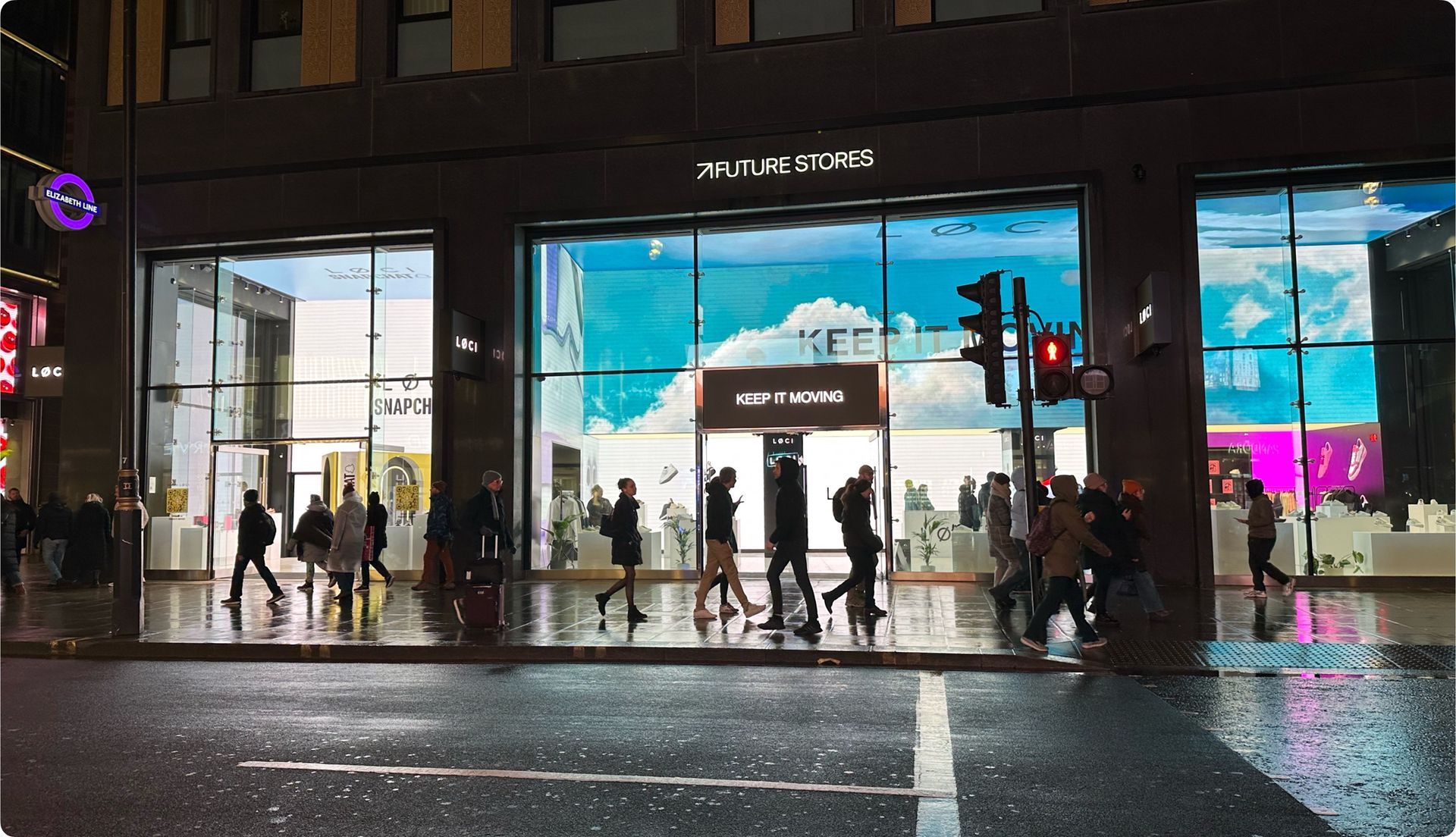
“The design we created for Future Stores in London is a prime example of what’s possible with LEDs,” Nick continues. “The digital displays cover almost every surface. Every wall to floor, even the ceiling, acts as a canvas for content - and with a pixel pitch of just 1.5mm, shoppers can enjoy a truly immersive experience as soon as they step over the threshold.”
Similarly innovative, the Las Vegas Sphere demonstrates the scope and flexibility of LED displays. The Sphere features a 250-degree wrap-around LED display with 16K resolution. Stretching 366 ft high and 526 ft wide, it’s a spectacular showcase of this innovative technology.
LEDs can be configured to almost any scenario: they can be curved, flat or transparent and conform to any shape and size of space, including 3D geometric shapes.
One standout piece serves as the visual centerpiece of a Carnival Cruise ship. This 25-foot-tall LED-coated column greets guests in the ship’s atrium and displays a series of ever-changing images across its surface. The column also boasts a unique vortex shape that echoes a martini glass as its circumference expands from a 2.5-foot diameter stem to a 26-foot diameter summit.
Other noteworthy examples include the floor-to-ceiling displays that serve as a work of art in their own right at London’s Future Stores, the storytelling lift at the Museum of the Bible in Washington DC, and the expansive departmental displays at Scheels.
But while the logistical and technical scope of LEDs is expansive, the first question retailers should ask themselves before embracing digital displays is what they want to show on them?
Unfortunately, technical execution is often considered before content when, ideally, these should be tackled simultaneously and work in tandem.
“Brands often think about filling a surface with a canvas but fail to consider what they need to show on it,” explains Greg.
Carefully planning and creating content for each individual display is an exercise that can reap rewards, not only in helping retailers create extraordinary experiences but also in influencing shopper behaviour.
“When you really think through the connection between content and your displays, you can guide the shoppers through your store in a very intentional yet gentle way,” continues Nick.
As LEDs evolve, the potential for engineering something exceptional becomes ever greater.
“I’ve seen 16K artwork footage on an LED display, which was so compelling because you could see the brush strokes, every nuance of the image. It wasn’t a TV screen anymore, it was a work of art,” explains Nick. “And it’s not only the quality that excites me, you’ve now got LED floors you can walk on, 3D images that can wrap around, and thinner pixels with pitches of 0.4mm or less that could lead to LED becoming as versatile as wallpaper in the near future.”
To paraphrase a famed slogan, the future’s bright, the future is LED displays!